






Two agents open the same AI tool on the same morning.
The first one types “write me a caption for this listing,” copies the result, pastes it into Instagram, and closes the tab. She’ll repeat this exact motion a dozen times this week – same tool, same task, same amount of her own time spent every single round.
The second one describes an outcome – audit my last 30 days of content and tell me what’s actually converting versus what’s just getting likes – and walks away. She comes back to a finished analysis she didn’t have to build herself.
Same tool. Completely different result. The difference isn’t skill. It’s whether AI is being used as a notepad or handed something to actually run.
The Notepad Problem
Most real estate agents are stuck in the first mode without realizing there’s a second one.
Call it the notepad problem: AI stays a tool you talk at instead of a team member you hand things to. Open the tab, type a request, copy the output, close the tab – and repeat, every time, forever. It never actually leaves the desk. It just waits for the next prompt, like a very smart notepad.
The real leverage – the part that removes a task from the to-do list entirely instead of just making one task faster – never gets touched.
This matters more in a real estate business than almost any other kind of small business, because so much of the day is repetitive by nature: follow-up messages, content, audits of what’s working, routine analysis that has to happen the same way every week. Those are exactly the tasks that are safest to delegate, because they follow a pattern.
The AI Leverage Checklist for Real Estate Agents
Before deciding what to delegate, it helps to see clearly where AI currently sits in a weekly routine. Walk through these five checkpoints honestly.
What is AI currently being used for? Captions, listing descriptions, the occasional email – or does it touch anything that isn’t writing? There’s nothing wrong with starting here. It’s the floor, not the ceiling.
Has a task ever actually been handed off and left alone? Or does every interaction require sitting there the whole time – prompting, copying, pasting? This is the real line between using a tool and delegating to a team member.
Does the AI already know anything about the business, or does it start from zero every time? Re-explaining brand voice, market, and systems in every new conversation is setup work that should only need to happen once.
Could AI run a real audit (leads, content, follow-up) without a person doing the analysis first? If that’s untested, it’s worth trying this week.
Is there a task on today’s list that’s really “someone needs to do this,” not “only I can do this”? There’s usually at least one.
What Delegating to AI Actually Looks Like
An audit is a useful place to see the difference in action. Instead of reviewing thirty days of content manually: scrolling back through posts, checking which ones led to DMs or comments, noting which ones had no clear call to action…the task can be described as a goal: review the last month of content and identify what’s converting versus what’s just getting engagement, then flag anything missing a clear next step.
The output isn’t a rewritten post. It’s an actual analysis – the kind of pattern-spotting that would otherwise take an hour of manual review, done in the background while attention goes elsewhere.
This is the shift Claude’s Cowork feature is built around: instead of a single prompt-and-response exchange, a task is described as an outcome, Claude works across connected files and tools to complete it, and the result comes back ready for review. It’s available on Claude’s paid plans and currently rolling out across desktop, web, and mobile. Review still matters – nothing client-facing should go out unchecked – but the difference between drafting something from scratch and reviewing a finished first pass is significant.
The Order to Hand Things Off In
Delegating everything at once creates a different kind of chaos, not less of it. There’s a sequence that actually works.
Start with audits and analysis. Low risk, high clarity. Let AI surface what’s actually happening in the business – what’s converting, where follow-up is breaking down – before deciding what to fix.
Then repetitive writing. The variations that have already been written a hundred times: descriptions, follow-up messages, caption drafts. This works best once brand voice and templates are documented somewhere AI can reference.
Then automations and workflows. Tasks with a repeatable structure that don’t need a new decision every time — a morning briefing, recurring reports, routine follow-ups.
Then full task hand-off. Describe an outcome, walk away, come back to finished work. This is the ceiling, not the starting point — it works well specifically because the first three steps are already solid.
Which Stage Is the Right Starting Point?
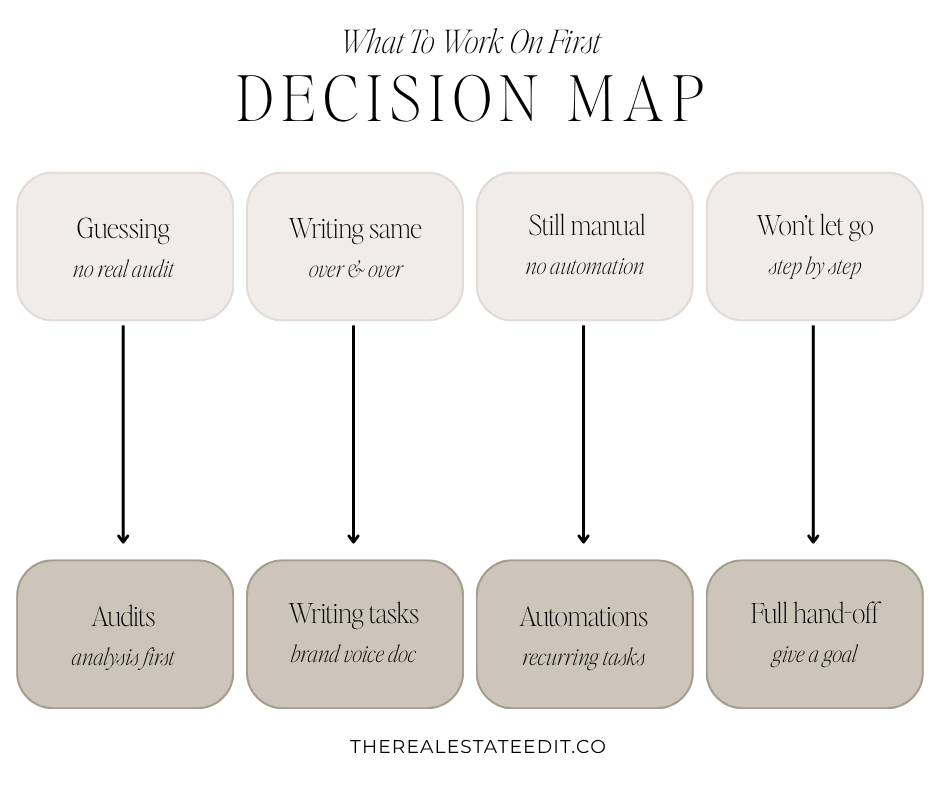
- Genuinely unsure what’s working right now → start with audits
- Writing the same kind of message or caption constantly → document a voice and template set
- Doing something manually that follows the same pattern every time → build the automation
- Comfortable with the first three, ready to actually delegate a full task → try a real hand-off
Is It Safe to Delegate Real Business Tasks to AI?
This is the question underneath most of the hesitation, and it’s a fair one. The honest answer is that delegation doesn’t mean removing oversight – it means moving the oversight to review instead of production. A task handed off still gets reviewed before anything goes to a client or goes live; what changes is that a first pass already exists instead of starting from a blank page. Starting with lower-stakes tasks – audits, internal analysis, drafts that will be reviewed anyway – is the natural on-ramp before handing off anything client-facing.
The Takeaway
The gap between an agent who’s “used AI” and an agent whose business is actually supported by it usually isn’t a skill gap. It’s a delegation gap – the difference between talking to a notepad and handing something to a team member. Most agents already have access to the second version. Most just haven’t tried it yet.


+ show Comments
- Hide Comments
add a comment