





You set your alarm for 6 a.m. with the best intentions. You’re going to lead generate hard today. Hit the phones. Send those emails. Post on Instagram. Basically… do all the things.
By 10 a.m. you’ve checked your inbox, put out two fires, answered a client text and doom scrolled a hundred posts from other agents who seem to have figured something out that you haven’t.
Noon rolls around … and the momentum is gone.
Here’s what I want you hear: this is not a motivation problem. It’s not a ‘the market is tough right now’ problem. And it’s not even a you problem.
It’s because you don’t have the right system to help you do the hard stuff.
Most real estate agents don’t have a lead generation system. They have a lead generation scramble – a collection of efforts, platforms and tactics that run on willpower instead of infrastructure. The problem is that willpower runs out.
What The Real Estate Edit was built on, and what we’re going to walk through in this post, is something totally different. It’s called lead attraction – and once you understand the difference between chasing leads and attracting them, everything about how you approach your business changes.
Why Lead Generation Feels Exhausting (And Why That’s Actually Good News)
Before we get into the ‘how’, I want to name what’s actually happening – because most real estate agents blame themselves for something that was never their fault.
The lead generation advice that’s been handed down in real estate for decades was built for a different time, a different market, and frankly, a different type of agent. Cold calling. Door knocking. Buying leads from real estate websites. Working the expired and FSBO lists.
None of those are wrong. But they all share one thing in common: they require you to constantly show up and push for the result. The moment you stop, the leads stop.
That’s not a system. That’s a job on top of running your business.
But also, for most women in the space – these methods feel icky, inauthentic & too aggressive for how our minds work.
And here’s the bigger problem. The approach was designed around volume and interruption. (Check out this post on Active vs. Passive Lead Generation.) You reach out to enough strangers and statistically, one of them will eventually say yes. But in 2026, buyers and sellers are more skeptical, more research-driven and more immune to interruption than ever.
The agents winning right now are not the loudest. They’re the most trusted.
And trust isn’t built through cold outreach. It’s built through consistent valuable presence – through content that makes someone feel understood before you’ve ever had a conversation.
That’s the shift. From chasing to attracting. From pushing to pulling.
The exhaustion you’ve been feeling isn’t evidence that you’re bad at this. It’s evidence that you’ve been doing soemthing designed to be exhausting. There’s a better way.
The Difference Between Lead Chasing and Lead Attraction
I want to give you a picture that I’ve used with real estate agents for years – because it makes this concrete immediately.
Think about the last time you planted something in your yard – or tried to. The plants that thrive are the ones with a system underneath them. A watering schedule. The right soil. A spot with the right light. They don’t need you to manually tend to every inch of them every single day. The system does most of the work. You just maintain it.
The plants that die? They’re the ones depending entirely on you showing up. The moment you get busy, they wither.
Your lead generation works exactly the same way.
Lead chasing is manual tending. It requires your presence and your energy every single day. Take a day off, take a vacation, have a hard week – and the pipeline dries up. The income becomes unpredictable. The business becomes a source of anxiety instead of freedom.
Lead attraction is building the irrigation system. You set it up once, you maintain it, and it does the heavy lifting whether you’re in a showing, on a flight, or spending a Tuesday with your kids.
The difference in practice looks like this:
Lead chasing looks like scrolling through Zillow leads, sending one follow-up email, giving up when they don’t respond, prospecting when you’re anxious about income, and starting from scratch every single month.
Lead attraction looks like showing up consistently online, building an audience that knows and trusts you, capturing leads automatically through systems you’ve set up in advance, and nurturing them over time without manually touching each one.
One is reactive. One is proactive. One runs on willpower. One runs on infrastructure.
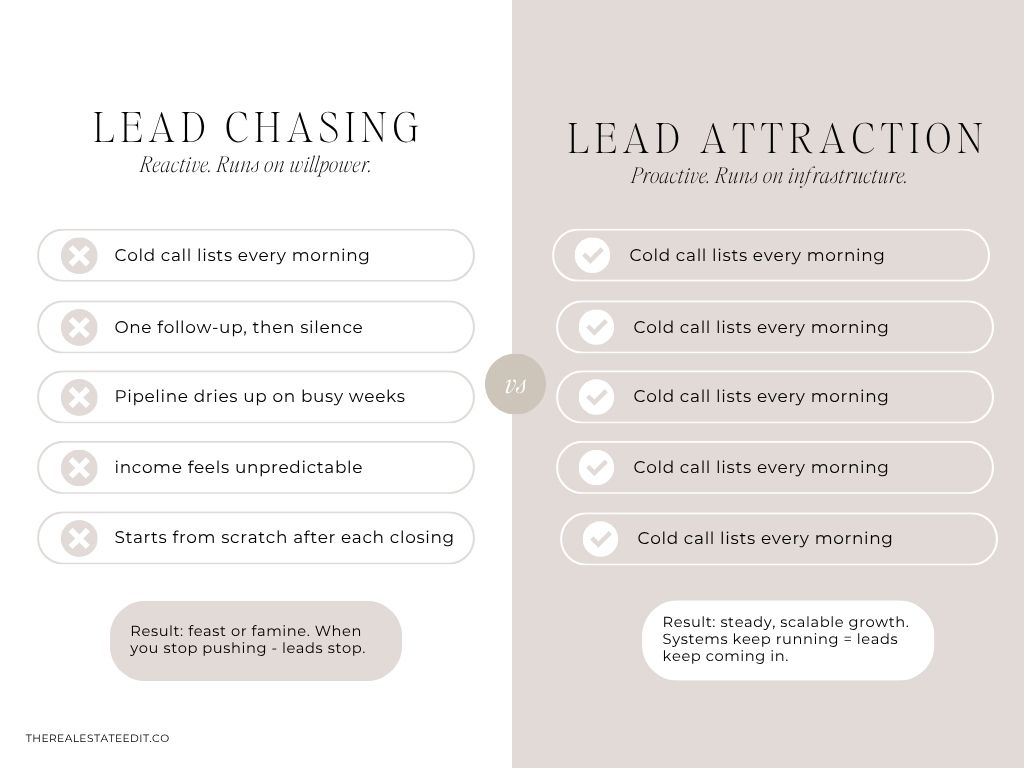
The goal of everything we do at The Real Estate Edit – is to help you build the second kind of business.
The 4-Part Lead Attraction System
Here’s the framework. Four components that work together as a system – not four separate tactics you try independently. The magic is in how they connect.
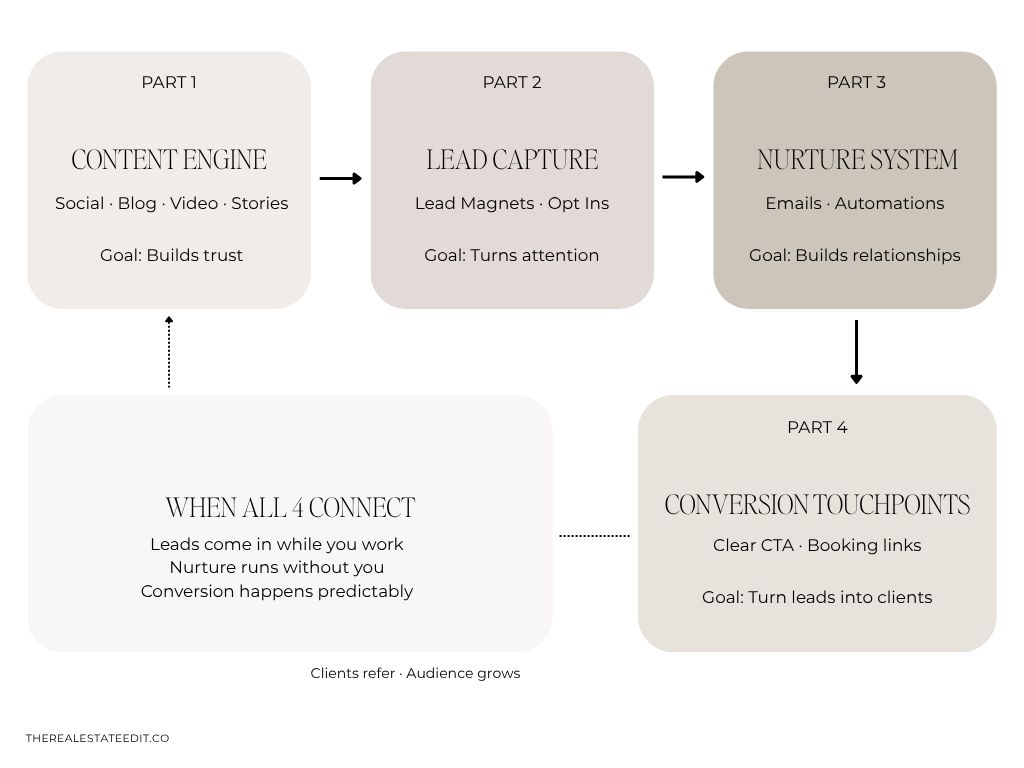
Part 1: Your Content Engine
Your content is how strangers become aware of you. It’s how you demonstrate expertise before anyone has asked you a question. And done right, it’s how you build the kind of trust that makes someone DM you six months after following you and say, I’ve been watching your content and I’m ready to work with you.
That actually happens. Regularly. For agents who show up with intention.
Here’s what intentional content means in practice: it’s not random. Every post, every video, every story has a purpose – to educate, to connect, or to make your ideal client feel understood.
The agents who struggle with content are usually doing one of two things. Either they’re posting inconsistently (brilliant content one week, silence the next), or they’re posting consistently but without a clear point of view. Generic market updates, listing announcements, and “congratulations to my buyers!” posts don’t build an audience. They fill space.
What builds an audience is having something to say. A specific type of client you serve. A take on what’s happening in the market. A way of explaining the process that makes someone feel less overwhelmed. Your perspective.
You don’t need to be on every platform. You need to be consistent on the platforms where your ideal client actually spends time – and you need to show up there as someone worth following, not just someone who sells houses.
Instagram remains the primary platform for most women in real estate right now, but the principle applies everywhere: long-form content (blog posts, YouTube videos, podcasts) builds authority and trust over time. Short-form content (social posts, reels, stories) keeps you visible and drives people toward that long-form foundation.
One framework that helps: think of your long-form content as the tree. Your social content is the branches – shorter pieces that spread out and reach people who might never find the original. Create the root content once and let it branch.
Part 2: Your Lead Capture System
Content builds awareness. But awareness doesn’t automatically become leads. There has to be a bridge – a way for someone who’s interested to raise their hand and let you into their world.
That bridge is your lead capture system.
This looks like lead magnets (a free guide, a market report, a checklist) that give someone a reason to share their email address. It looks like opt-in pages that are clear about what they’re offering and who it’s for. It looks like calls to action in your content that make the next step obvious.
The most common mistake here is making the ask too complicated or too vague. “Sign up for my newsletter” is not a compelling offer. “Download the free guide: 7 questions every first-time buyer should ask their agent before signing anything” – that’s specific, that’s useful, that’s worth an email address.
Your lead magnet should solve one small, specific problem for your ideal client. It should leave them feeling genuinely helped and quietly wanting more. That’s the entry point into your world.
Once someone opts in, they’re no longer a follower – they’re a lead. And that’s where Part 3 takes over.
Part 3: Your Nurture System
This is where most agents completely drop the ball.
Here’s a story I tell a lot because it hits close to home. A few years into building my own lead generation system, I had generated over 2,700 leads in six months. Sounds incredible, right?
I was closing about 3 deals a month.
When I dug into the numbers, I realized I should have been converting roughly 2 to 3 percent of those leads – somewhere around 13 new clients every month. Instead I was converting a fraction of that.
I did what most of us do: I blamed the leads. Said they were low quality. Switched platforms. Told myself the source was the problem.
Then one day I got an email from Bath and Body Works about their Semi-Annual Sale. It said it was the final day – and I had no idea the sale was even happening. I went back through my inbox and found I’d received almost daily emails about it for four weeks. I’d been getting app notifications too. Every single one had slipped past me.
And it hit me: if they had only sent me one email, I never would have known the sale existed.
That was exactly what I was doing with my leads. One touch. Maybe two if the lead seemed warm. No response? Straight into the “dead leads” pile.
The reality is that most buyers and sellers are in a research phase for weeks, sometimes months, before they’re ready to have a real conversation. If you’re not staying in front of them during that time — with value, not pressure – someone else will be.
A nurture system is the automated sequence of emails, messages, and touchpoints that keeps you present and relevant to your leads without you manually reaching out to each one. It runs in the background. It adds value. It builds trust over time.
The key word is automated. Once you’ve set this up, it runs whether you’re busy or not. Your leads are being nurtured while you’re in showings. While you’re on vacation. While you sleep.
When I finally implemented a real nurture sequence – value-based emails spaced out over several weeks, a combination of check-ins and genuinely useful content – my conversion rate doubled within three months. Not because I had better leads. Because I stopped letting the good ones go cold.
Part 4: Your Conversion Touchpoints
The nurture system keeps people warm. Conversion touchpoints are the specific moments that move a warm lead to a ready client.
This is not about being pushy. It’s about making the next step obvious when someone is ready for it.
Conversion touchpoints look like: a clear CTA at the end of your emails (“When you’re ready to talk about what buying in this market actually looks like, here’s how to reach me”). A booking link that’s easy to find. A follow-up that arrives at the right time. A DM response that answers the question they actually had.
The biggest thing to understand here is that conversion rarely happens from a single touchpoint. Research consistently shows that most clients need multiple contacts before they take action — some sources put that number at five or more. This is not about pestering people. It’s about staying consistently present across multiple channels – email, social, direct message – so that when they’re ready, you’re the obvious person they call.
Timing matters too. Following up within 24 hours of initial contact, then at regular intervals after that, keeps the relationship warm without overwhelming anyone. The goal is to show up as a resource, not a salesperson.
What This Looks Like When It’s Actually Working
I want to paint you a picture, because the system I just described can sound abstract until you see it in motion.
An agent who has this working doesn’t start every month wondering where the next client is coming from. She has a content calendar that keeps her visible. She has a lead magnet that’s quietly collecting email addresses while she’s doing other things. She has a nurture sequence running in the background that’s building relationships with people she hasn’t even met yet.
She wakes up to leads. Not every day – but consistently enough that her pipeline feels steady rather than panicked.
Her follow-up doesn’t rely on her remembering to do it. Her client onboarding doesn’t reset to manual every time. Her marketing doesn’t stop when life gets busy.
That’s not magic. That’s infrastructure.
I’ve seen this transformation happen with agents at every production level – brand new agents who built their foundation right from the start, and seasoned agents who had been winging it for years and finally decided to build the system underneath the business they already had.
The agents who get there fastest have one thing in common: they stopped trying to do everything manually and started investing in the systems that could do the heavy lifting for them.
One agent I worked with, Kelly, was so overwhelmed that she documented her week minute by minute at my request. It came back as a ten-page single-spaced schedule that ran until after 11 p.m. most nights. She had no margin. No room to even consider bringing in more clients.
When we built her automation infrastructure – email sequences, a content system, automated client onboarding – she was able to remove those repetitive tasks from her daily load entirely. Within a few months, she had cut her workweek in half while growing her business.
That’s what systems make possible. Not just more leads. More life.
The Tools That Make It Possible
I’m not going to turn this into a tech tutorial, but I do want to be honest about what it actually takes to run this system, because there’s a version of this where you’re duct-taping together five different tools that don’t talk to each other — and that creates its own kind of chaos.
What you need, practically speaking:
A way to capture leads: landing pages, opt-in forms, a lead magnet delivery system.
A way to nurture leads: email marketing with automation sequences, not just a newsletter blast.
A way to manage your pipeline: a CRM that actually works the way agents work, not a generic sales tool that wasn’t built for real estate.
A way to stay visible: a content system and social scheduling that doesn’t require you to be glued to your phone.
When these tools are disconnected, the gaps between them are where leads fall through. Someone opts in but the welcome email doesn’t trigger. A lead goes cold because the follow-up reminder never fired. A client’s birthday passes with no touchpoint because nothing was tracking it.
The reason I built The Suite was to solve exactly this problem – to give women in real estate one platform where the lead capture, the nurture sequences, the CRM, the automations, and the content tools all live together and actually talk to each other. It’s built around how agents actually work, not how a generic sales team works.
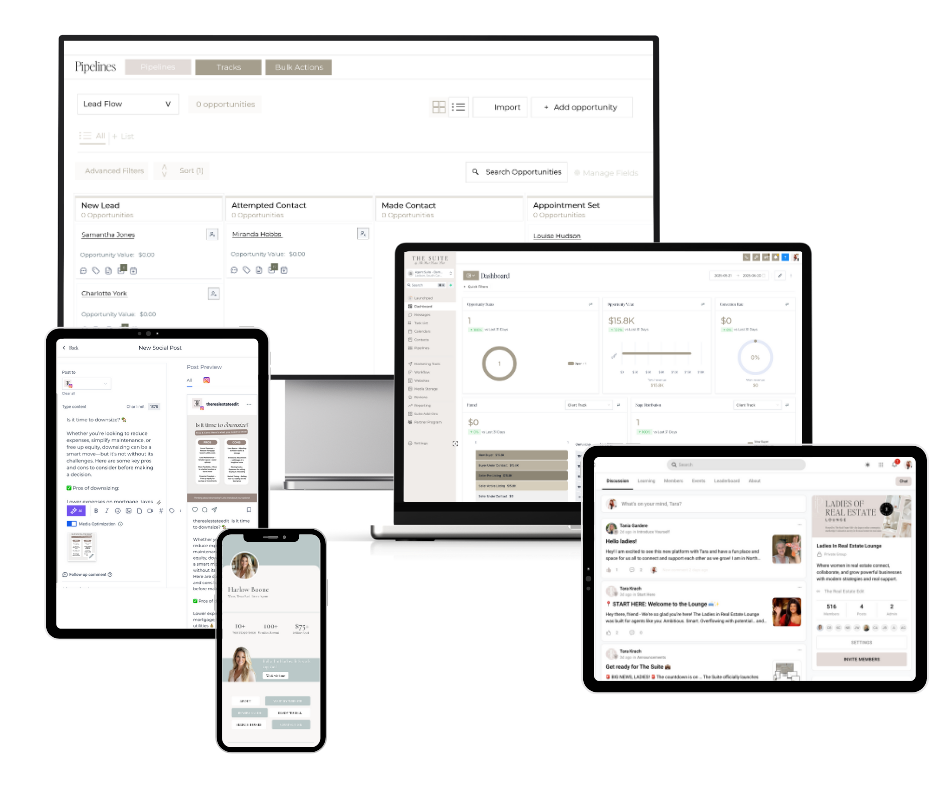
If you want to see how it works, you can check out a behind the scenes look here.
But regardless of what tools you use – the most important thing is that they’re connected, that they work together, and that they reduce the number of manual steps between “lead shows up” and “lead becomes client.”
Your Next Step
If you’ve read this far, something in here landed for you.
Maybe it’s the realization that you’ve been chasing instead of attracting. Maybe it’s the nurture gap — seeing yourself in that Bath and Body Works story. Maybe it’s the systems piece – knowing your backend is duct-taped together and quietly dreading the day it falls apart.
Wherever you are, the path forward is the same: build the system before you need it.
Don’t wait until the pipeline is dry to set up the nurture sequence. Don’t wait until you’re burned out to automate the follow-up. Don’t wait until you’re overwhelmed to build the infrastructure that creates margin.
The agents who build sustainable, scalable businesses (businesses that feel calm and profitable even when the market is unpredictable) are the ones who invested in their systems before they were desperate.
You don’t have to do everything at once. Pick the piece of this framework that’s most broken in your business right now and start there. Content first if you have no audience. Lead capture if you have an audience but no list. Nurture if you have a list you’re not using. Systems if you’re drowning in manual work.
One step at a time. One system at a time.
That’s how you build a business you’re obsessed with.


+ show Comments
- Hide Comments
add a comment